How to Launch a Private Label Kitchen Utensil Line: Low MOQ, Custom Branding & Packaging Guide
Launching a kitchen utensil line does not always require a huge first order. The smarter question is not “How many pieces can I buy?” It is “Which level of customization fits the stage of my brand?”
For Amazon sellers, cross-border e-commerce teams, brand owners, and import wholesalers, the answer often starts with two practical entry points:
1,000 pieces for standard models with logo printing
3,600 pieces for new mold development or deeper product customization
Both routes can work. The right choice depends on budget, lead time, product positioning, and how much brand difference the market really needs.
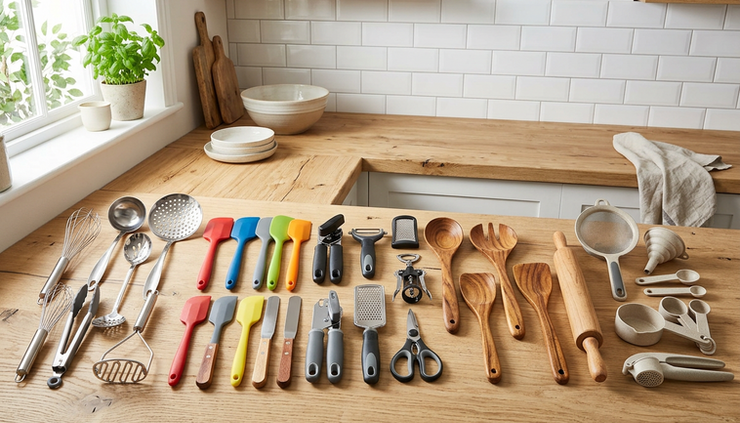
Start with the right customization level
A private label kitchen utensil project usually falls into one of two paths.
The first path is standard model customization. This means choosing an existing utensil design, then adding a logo, custom color, packaging, barcode, or FNSKU label. It is faster, lower risk, and suitable for testing a new Amazon listing or expanding an existing product line.
The second path is private mold customization. This means creating a new shape, handle structure, size, texture, tool head, or set combination. It gives stronger product ownership, but it requires more planning and a higher starting quantity.
For many sellers, the best launch strategy is simple: test demand with a standard model, then move into private mold customization once sales data supports the investment.
Compare 1,000 pieces logo printing and 3,600 pieces private mold customization
The difference between 1,000 pieces and 3,600 pieces is not just quantity. It affects cost, timing, packaging decisions, and how much control the brand has over the final product.
Launch option | Best for | What can be customized | Main advantage | Main limitation |
1,000 pieces standard model with logo | Amazon test orders, small brand launches, importer trial orders | Logo, basic color, packaging, barcode, FNSKU label | Lower entry point and faster launch | Product shape is usually fixed |
3,600 pieces private mold customization | Brand-owned product lines, exclusive SKUs, long-term programs | Mold, handle shape, color, material mix, packaging, set structure | Stronger differentiation and product control | Higher development cost and longer preparation |
For Private Label Kitchen Utensils, starting with 1,000 pieces is often enough to validate product style, reviews, price range, and packaging response. It works especially well for common items such as spatulas, ladles, turners, tongs, peelers, whisks, and measuring spoons.
The 3,600-piece route makes more sense when the product needs a clear physical difference. Examples include:
A special ergonomic TPR handle
A silicone tool head with a unique edge shape
A stainless steel utensil with a custom hanging hole
A wheat straw gadget set with a specific color system
A wooden handle series designed as a brand collection
If the product will compete mainly on listing photos and packaging, standard customization may be enough. If the product must feel different in the hand, private mold work becomes more valuable.
Choose materials based on brand position
Kitchen utensils look simple, but material choice changes the cost, user experience, and shelf appeal.
Stainless steel works for durability and a premium feel
Stainless steel utensils suit brands that want a clean, long-lasting, classic look. They work well for ladles, skimmers, turners, tongs, and whisks. Stainless steel also pairs well with TPR, silicone, or wooden handles.
For Amazon listings, stainless steel can support product claims around durability and daily use. The product still needs accurate descriptions and proper testing for the target market.
TPR handles add grip and color flexibility
TPR is a useful material for handles because it feels soft, offers grip, and accepts color customization. It is especially helpful when the brand wants a modern kitchen look without moving into a fully custom mold.
A dual-color TPR handle can make a common utensil look more brand-owned, even when the tool head is a standard mold.
Wood handles create a natural style
Wooden handles work well for brands focused on warm, natural, or farmhouse kitchen design. They pair especially well with silicone spatulas, stainless steel heads, and giftable utensil sets.
Wood requires attention to finish, color consistency, and packaging protection. Since wood grains vary, product photos and customer expectations should be managed carefully.
Silicone supports colorful and heat-resistant product lines
Silicone is common for spatulas, spoons, basting brushes, and baking tools. It offers strong color options and a soft feel. For brands selling sets, silicone makes it easier to create a unified color story.
When developing silicone kitchen tools, confirm the grade, intended use, and compliance requirements for the target sales region.
Wheat straw material fits eco-positioned product ranges
Wheat straw kitchen gadgets are common in measuring cups, peelers, cutting tools, and storage-related items. They are often used by brands that want a lighter environmental story.
Packaging should support the same message. An FSC kraft paper box often fits better than a glossy luxury box for this type of line.
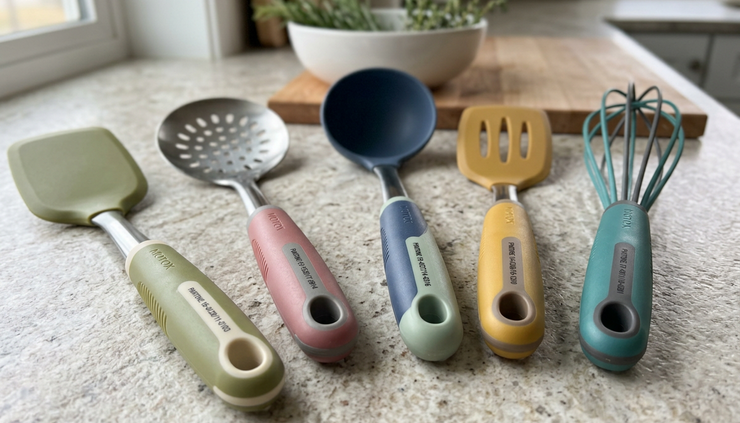
Use dual-color handles to create visible brand difference
A strong kitchen utensil line needs more than a logo. On Amazon and wholesale catalogs, buyers compare images quickly. Color becomes one of the fastest ways to signal brand identity.
Dual-color handles are a practical way to make Custom Brand Kitchen Gadgets look more distinctive without redesigning every tool from scratch.
Common dual-color approaches include:
A main handle color with a contrasting end cap
A soft-touch grip insert in a second color
A hanging hole area in a brand accent color
A two-tone split between front and back grip surfaces
Pantone color matching helps keep the series consistent. For example, a brand might use sage green and cream across spatulas, ladles, tongs, and peelers. Another brand might choose charcoal and copper for a more premium look.
The goal is not to use loud colors. The goal is to make the product instantly recognizable across listings, packaging, and repeat orders.
When planning Pantone customization, keep these points in mind:
Confirm colors on physical samples, not only digital screens
Expect small color differences between TPR, silicone, plastic, and printed packaging
Keep one main color system across the full utensil line
Avoid too many colors in the first launch, unless the set concept requires it
A good Low MOQ Kitchenware Manufacturer should be able to explain which color options are realistic at 1,000 pieces and which require a higher order quantity.
Treat packaging as part of the product
For Amazon sellers and import wholesalers, packaging is not only decoration. It affects customer trust, warehouse handling, scanning, gifting, and returns.
A strong packaging plan usually includes three parts: structure, design, and labeling.
Color box design helps products sell faster
A color box gives the product more shelf and gift value. It can show the utensil set, material features, care instructions, and brand story.
For Amazon, the box also helps protect the product during inbound shipping and final delivery. The structure should fit the utensil length, handle shape, and set quantity. A beautiful box that crushes easily creates a poor customer experience.
Good color box design should include:
Clear product name
Main material information
Quantity or set contents
Basic care instructions
Brand logo
Required symbols or compliance marks, where applicable
Barcode area with enough white space
Avoid filling every surface. Clean packaging often looks more premium than crowded packaging.
FSC kraft paper boxes support natural and eco-focused lines
FSC-certified kraft paper boxes are popular for wood handle utensils, silicone tools in natural colors, and wheat straw kitchen gadgets. They give a simple, responsible impression and match eco-positioned products well.
The important point is consistency. A kraft box works best when the product color, material, and brand message all point in the same direction. If the utensil line uses bright neon handles, a natural kraft box may feel disconnected.
Since certification claims can be sensitive, confirm the packaging supplier’s documentation before printing FSC marks or environmental statements.
Barcode and FNSKU labeling need early planning
Amazon packaging must be practical. Barcode and FNSKU labels should not be treated as the final detail.
Plan these before mass production:
Where the barcode will be printed or labeled
Whether the FNSKU goes on the product, polybag, inner box, or outer box
Whether the carton needs shipping marks
Whether each set needs a suffocation warning on the bag
Whether mixed SKUs require clear separation
Printed barcodes look cleaner, but sticker labels add flexibility when SKUs change. For first orders, many sellers prefer labeling because it reduces the risk of printing the wrong code on finished boxes.
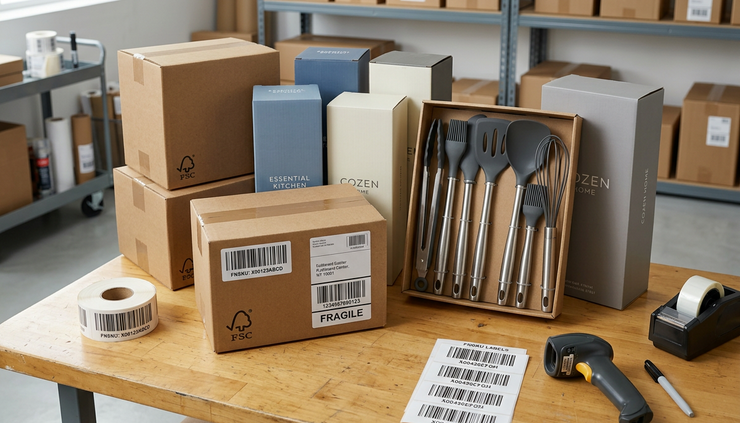
Build the launch plan around risk control
A private label kitchen utensil launch should balance ambition and control. A practical first order often follows this pattern:
Choose 3 to 6 core utensils or one complete set.
Select the material direction, such as stainless steel, silicone, TPR, wood, or wheat straw.
Request standard model samples first.
Confirm logo method, handle color, and packaging structure.
Build the color system around one or two Pantone tones.
Prepare barcodes, FNSKU labels, and carton marks before production.
Start with 1,000 pieces if testing the market.
Move to 3,600 pieces or private mold work after the product proves demand.
This approach keeps the first launch manageable. It also gives the brand space to improve the second order with real feedback from customers, reviews, returns, and sell-through data.
Know when private mold customization is worth it
Private mold development is not only for large brands. It can be the right step when a standard model blocks growth.
Consider private mold customization when:
Many competitors sell the same visible product
Reviews show repeated complaints about handle comfort or size
The brand wants exclusive design control
Wholesale buyers request something different from catalog items
A full utensil family needs a unified shape and grip style
Private mold work should solve a real product problem. A new mold that only looks slightly different may not justify the cost. A better grip, smarter storage design, improved tool angle, or more consistent set identity can.
For a growing kitchenware brand, the strongest path is often staged. Start with low MOQ logo customization, learn from the market, then invest in private mold design where it can improve the product and protect the brand.
A successful launch is not only about getting utensils made. It is about matching quantity, material, color, packaging, and labeling to the way the product will actually sell. Start with the MOQ that fits the risk, make the brand visible through color and packaging, and build toward deeper customization when demand is clear.
Take the Next Step with Kimberi
Sourcing your custom kitchen line with Kimberi ensures:
Flexible Minimums: 1,000 pcs for custom branding | 3,600 pcs for custom molds.
Turnkey Branding: Laser logos, Pantone-matched grips, and retail-ready packaging.
Global Compliance: Certified raw materials meeting FDA and LFGB standards.
Skip the middleman and work directly with our manufacturing facility in Yangjiang.
Comments